Runway Open-Sources Praxis-1, Its Video-Trained Robot Action Model, Under Apache 2.0 License
The generative video specialist has released the weights for Praxis-1, a 27-billion-parameter model that predicts both video and robot movements. Under an Apache 2.0 license—commercial use included—inference and fine-tuning code are provided, with Runway ranking it as the leading open-weight model on NVIDIA's RoboLab-120 benchmark.


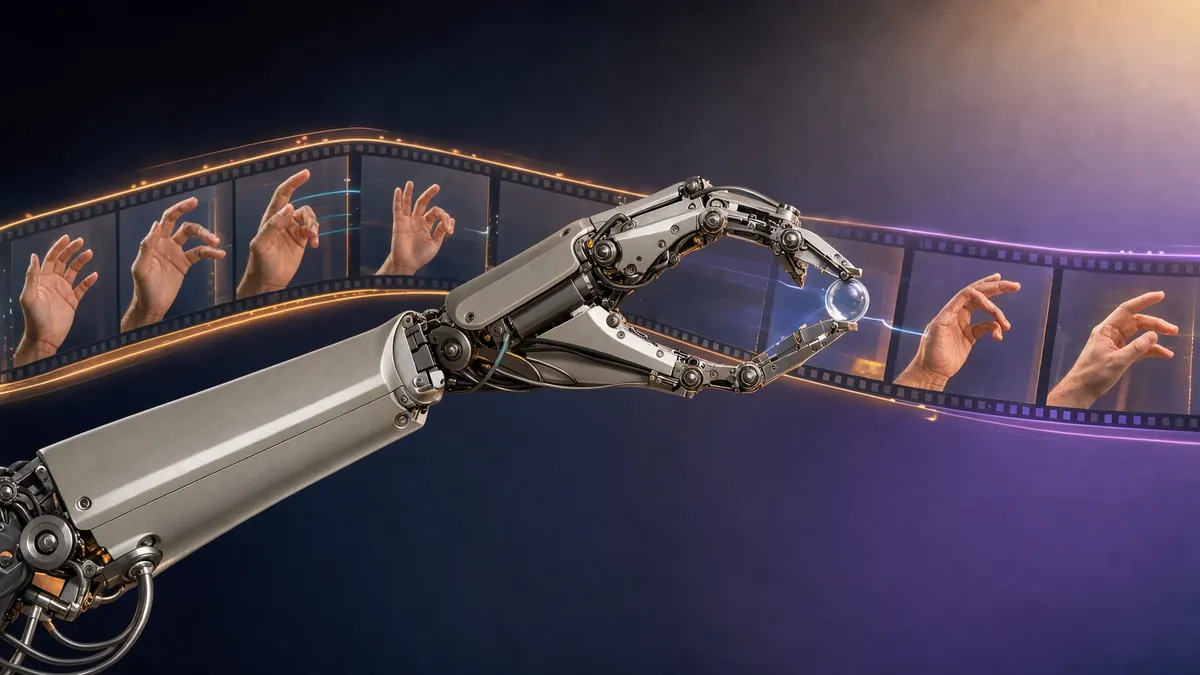
Runway, known for its generative video tools, has released the weights for Praxis-1, its robot control model, under an Apache 2.0 license. The November 11 announcement delivers on a commitment made in September, when the company introduced this first “world action model”: a system that learns how the physical world moves by watching video, and then applies that understanding to steer a mechanical arm.
From generative video to robotic motion
The premise is simple to state. Real-world robotics data is scarce and expensive to gather; ordinary video, by contrast, is abundant. Runway took its in-house video model, a Mixture-of-Experts diffusion transformer, and retrained it on footage of hands and robots at work. The technical report details the architecture: a video network that anticipates how the visual scene will unfold, coupled with a compact “action expert” (around 314 million parameters) that reads these predictions to infer the necessary movements. With each call, the model takes in the prompt, recent camera feeds, and the robot’s current position, outputting 1.6 seconds of action—amounting to 24 control commands at 15 Hz.
The entire model encompasses 27.2 billion parameters, with roughly 2.8 billion active per token in the video component, and fits onto a single 80 GB GPU (54.4 GB in bf16). On an H100, an inference step takes about 0.55 to 0.6 seconds, roughly one-third of the motion duration it generates.
What has been released
The license covers the weights, inference code, and fine-tuning pipelines—both full fine-tuning and LoRA—including for commercial applications. Three checkpoints have been uploaded to Hugging Face with native LeRobot integration: a version fine-tuned for the Franka arm (DROID dataset), another for the dual-arm YAM robot, and the base mid-trained model ready for custom hardware adaptation. Runway also provides a policy server, a MuJoCo simulation environment, and vLLM-Omni integration. According to the developer, the model runs across NVIDIA hardware, from the H100 down to the RTX 5090 and the Jetson Thor embedded module; the developer also stated that 4-bit quantized versions (NVFP4, 17.5 GB) will be released.
Figures to approach with caution
Runway positions Praxis-1 at the top of the “world action models” and open-weight entries on NVIDIA’s RoboLab-120 benchmark, reporting a 46.2% success rate in simulation, ahead of Black Forest Labs’ FLUX 3 Action (42.9%). The report itself points out that four entries achieved higher scores, including two agents powered by frontier models and two proprietary systems. On a physical Franka arm, the company reports 88 successes out of 100 trials, compared to 80 for FLUX 3 Action.
The most eye-catching benchmark compares Praxis-1 against GPT-6 Astra driving the same dual-arm YAM setup on identical workstations: 15.6 times faster and 51 times cheaper per successful task, according to Runway. These figures, however, stem from developer-run evaluations covering just three tasks. The report also highlights notable shortcomings: the robot occasionally grabs objects that merely resemble the target, struggles with ambiguous prompts, and falters when multi-step sequences are given in a single prompt.
Our take
The gesture matters just as much as the metrics. Facing established open models on the leaderboard like GR00T N1.6 and π0.5, a player from the generative video space has dropped an end-to-end robotics model under a genuinely permissive open-source license, backing the hypothesis that web video can offset the need for costly teleoperated demonstrations. For robotics teams, the upside is immediate: a foundational model fine-tunable via LoRA that fits on a single GPU. That said, the headline performance figures are largely evaluated in simulation or self-reported by Runway, and the Noble Machines setup has yet to be validated on physical hardware. Early feedback from the LeRobot community will soon reveal whether these laboratory gains hold up in the wild.
Sources
- Runway — Praxis-1 Is Now Available (November 11, 2026) Primary source
- Runway Research — Praxis-1: From Video Pretraining to Robot Control (technical report) Primary source
- Runway on X — Praxis-1 availability announcement (November 11, 2026) Primary source
A primary source comes directly from the company, lab or organization concerned. A secondary source reports the information without being its author: we flag it as such. Spotted an error? See our corrections policy.