Nvidia Unveils GR00T 2, a Model Predicting Video and Gestures to Train Robots from Human Footage
At the CoRL conference, Nvidia unveiled GR00T 2, a “world action model” that simultaneously predicts future video and robot movements. According to Nvidia, it succeeds on 40% of trials across 50 tasks never seen by the target robot, and hits 95% after five demonstrations and 30 minutes of fine-tuning on a single GPU.


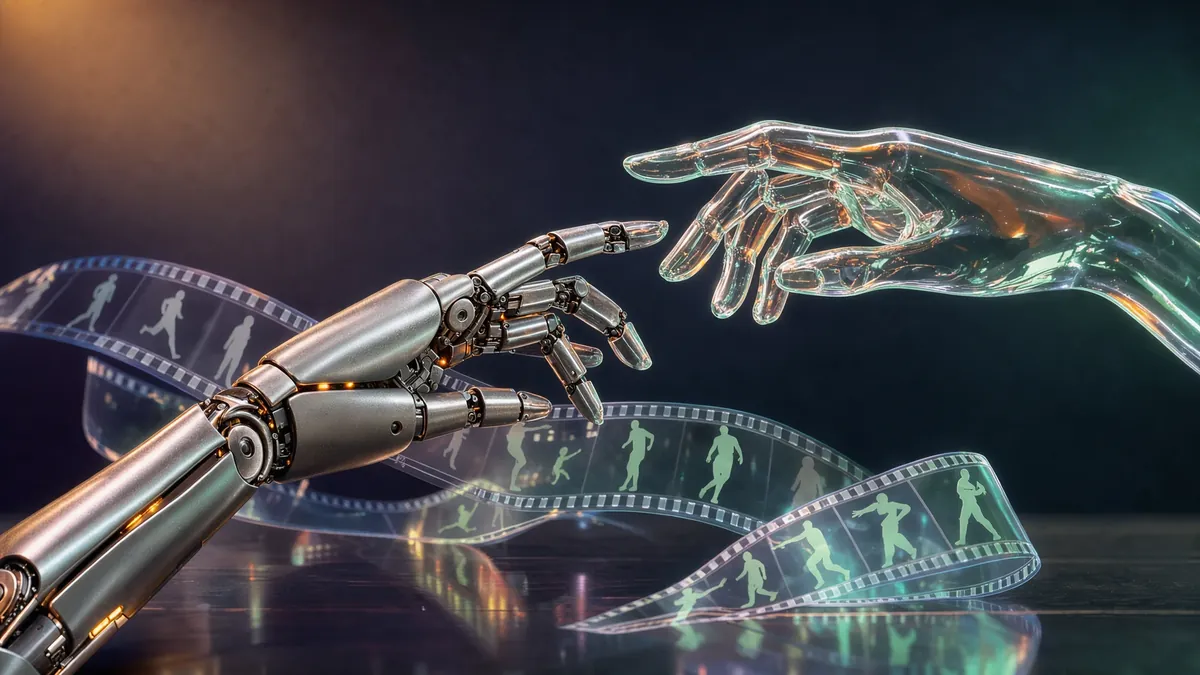
Following vision and language, robotics is now adopting models that “imagine” what comes next. On November 9 at the CoRL conference in Austin, Nvidia introduced GR00T 2, the next generation of its robotics foundation models. Its distinguishing feature: rather than merely picking a movement, it simultaneously predicts what the scene will look like a few moments later.
Predicting Video to Learn from Humans
GR00T 2 is a “world action model”: a single diffusion transformer jointly denoises future video—captured across three camera views—and a chunk of joint commands. Small robot-specific heads then translate this plan into motor commands, allowing the exact same model to control parallel grippers, five-fingered hands, or a full humanoid.
According to Nvidia, the advantage of predicting video is the ability to learn physics directly from human footage, which contains no robot telemetry. The pre-training dataset blends 402,730 hours of first-person egocentric video, around 10,000 hours of demonstrations with a handheld gripper, and 23,500 hours of robot teleoperation. Nvidia is releasing 100,000 hours of this human video on Hugging Face. The company’s internal benchmarks indicate that as the proportion of human video scales up, robot performance improves: across 72 tasks, real-world task progress increased from 50% to 70% between using zero human video and the full dataset.
High Generalization Numbers Awaiting Verification
The headline result involves 50 tasks that the target robot, equipped with two Sharpa hands, had never practiced before. Without any demonstrations, GR00T 2 succeeds on 40% of trials. A single demonstration per task boosts this rate to 71%, and five demonstrations lift it to 95%—amounting to less than three minutes of data and 30 minutes of fine-tuning on a single RTX 5090. Nvidia also highlighted skills learned solely by watching humans, such as lining a laboratory funnel with filter paper (65% success rate).
Another focal point is agent-driven control. A reasoning model calls GR00T 2 as a tool, checks step-by-step progress, and performs scene recovery whenever a part drops. In this setup, the YAM arm successfully assembles three toy kits in 97 to 98 out of 100 trials, compared to 23 to 69 trials using supervised fine-tuning alone. A lightweight variant, GR00T 2 Turbo (2 billion parameters), runs directly on board the Unitree G1 humanoid, delivering 124 ms per prediction.
Open, but Not Yet Downloadable
Nvidia positions GR00T 2 as an open model, in line with prior GR00T releases, and concurrently announced Isaac Lab 3.0 alongside two open benchmarks, DexBench and VABAR. However, nothing is downloadable just yet: the research page merely states that code will be “available in December,” without a firm release date or license terms, and without confirming whether weights will be shared at the same time. On the industrial side, Nvidia named Foxconn for server assembly, Siemens, and Nexuni, which is testing the model for laundry manipulation.
Our take
GR00T 2 highlights a broader shift: to achieve generalization, robotics foundation models are relying on massive human video datasets rather than expensive robot demonstrations, with video prediction acting as the bridge between the two. The numbers are impressive, but they originate entirely from Nvidia, tested on its own robots and benchmark tasks without external verification so far. The strategic objective is equally transparent: an open foundation model that runs optimally on Jetson chips and trains within Isaac Lab reinforces the entire Nvidia hardware and software ecosystem. A true assessment will have to wait until the code, weights, and licensing terms are actually released.
Sources
- Nvidia Research (GEAR) — GR00T 2: Scaling Robot Foundation Models for Generalization, Dexterity, and Adaptation (November 2026) Primary source
- Nvidia Blog — Practice Makes Precise: At CoRL, NVIDIA and Partners Reveal How Robots Rehearse Delicate Work in Simulation (November 9, 2026) Primary source
- The Robot Report — NVIDIA launches GR00T 2 and Isaac Lab 3.0 at CoRL (November 9, 2026) Secondary source
A primary source comes directly from the company, lab or organization concerned. A secondary source reports the information without being its author: we flag it as such. Spotted an error? See our corrections policy.