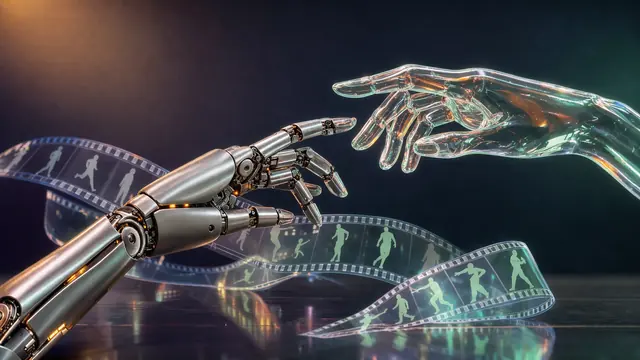
Robbyant (Ant Group) Releases LingBot-Touch, an Open Tactile Model for Robotic Hands
Robbyant, Ant Group's robotics subsidiary, has released LingBot-Touch under the Apache 2.0 license—a model that converts signals from three families of tactile sensors into a unified representation. The company claims an average success rate boost of 14 to 26 percentage points on fine manipulation tasks, figures that have not yet been independently replicated.

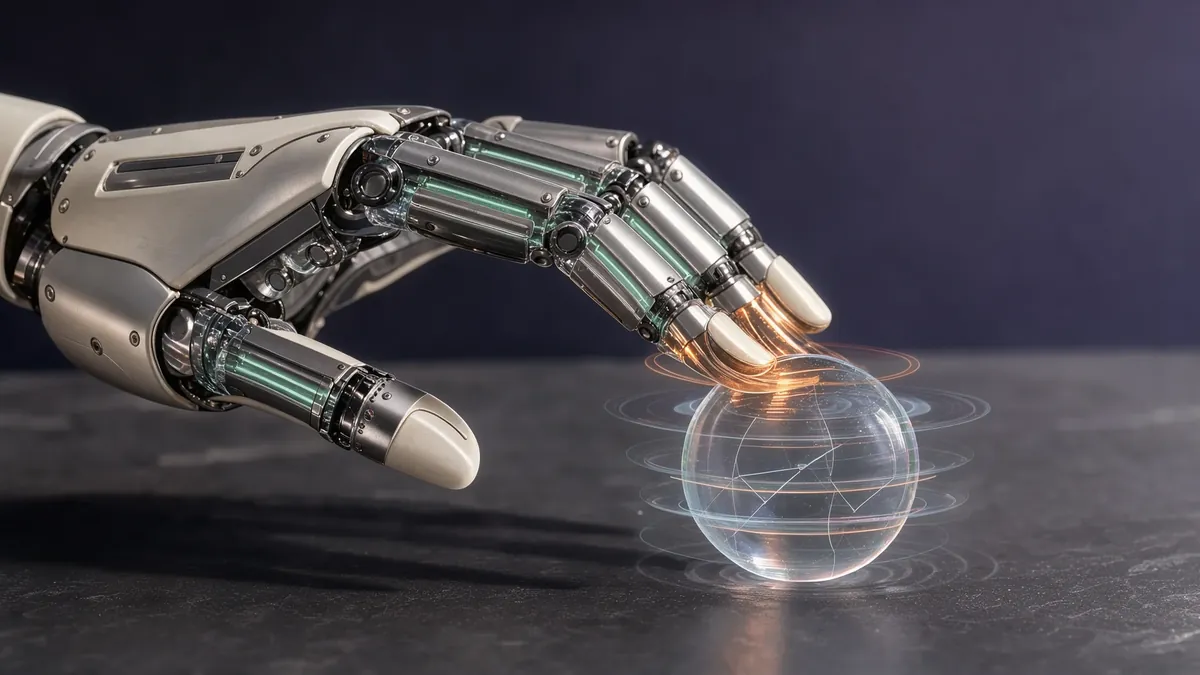
Robots are seeing better and better, but they still struggle to feel what they touch. Robbyant, Ant Group’s robotics subsidiary, has released LingBot-Touch, a foundation model for tactile sensing, with its weights under the Apache 2.0 license on Hugging Face and ModelScope, alongside inference code in a GitHub repository opened on November 9.
Three Sensor Families, a Single Representation
The issue LingBot-Touch tackles is very tangible: multiple artificial skin technologies exist, producing incompatible signals. Magnetic sensors measure forces across three axes, piezoresistive ones measure pressure, and visuotactile sensors track deformation captured by a small camera. Every robotic hand arrives with its own hardware, meaning data collected on one rarely transfers effectively to another.
The model relies on a dedicated tokenizer for each sensor type, followed by a shared Transformer trained in a JEPA-like framework: it learns to predict masked patches of the tactile signal in a latent space using their spatial and temporal context. At the output stage, it delivers tokens that preserve their “address” (timestamp, finger, position) and can be consumed by an action model. The repository also recommends querying these tokens using cross-attention rather than simple averaging, since each token already blends information drawn from other fingers and earlier moments in time.
Claimed Gains Across 26 Real-World Tasks
According to Robbyant, cited by Beijing Business Today, the model was pretrained on nearly 5,000 hours of real-world tactile data and then evaluated on 26 tasks using two robotic hands, the Sharpa Wave and the XHand1: turning a page, unscrewing a bottle cap, and recognizing mahjong tiles. Plugging LingBot-Touch into four action models (LingBot-VLA, π0.5, Diffusion Policy, and T-Rex) reportedly raised their average success rate by 14 to 26 percentage points compared to running without touch sensing. A highlighted example: unscrewing a bottle cap jumps from 56.25% without touch to 90% with the LingBot-Touch representation, compared to 62.5% when feeding raw signals directly. These numbers reflect the vendor’s claims.
What Is Actually Open
The release includes the frozen encoder and its configuration across two sizes (Tiny and Small). The GitHub repository adds inference code, adapters for Sharpa and XHand hands, code for resampling other sensors, and 120 example files. However, neither the training code nor task heads are published, and an approved account is required to download the weights. For a research lab, this is enough to extract tactile representations and test them on their own robotic hand; it is not enough to retrain the model.
Our take
Touch is one of the missing links in fine manipulation, and the concept of a unified representation across multiple sensor technologies is precisely what is needed to bring together currently fragmented datasets. Releasing under Apache 2.0 aligns Robbyant with moves from Nvidia or Skild, who are open-sourcing robotics building blocks to establish them as standards. The usual caveats apply: the performance claims originate from the vendor, on hands they selected, and the release stops at inference. The real test will be whether external research labs adopt it on different hardware.
Sources
- GitHub — Robbyant/lingbot-touch Primary source
- Hugging Face — robbyant/lingbot-touch-small Primary source
- Robbyant — Technology page (LingBot-Touch 1.0) Primary source
- Beijing Business Today via 10jqka — 蚂蚁灵波发布LingBot-Touch触觉基础模型 (November 10, 2026) Secondary source
A primary source comes directly from the company, lab or organization concerned. A secondary source reports the information without being its author: we flag it as such. Spotted an error? See our corrections policy.