BioBasicsBench: OpenAI and Ligo Test AI Agents on 100 Routine Biology Lab Tasks
On November 6, OpenAI released BioBasicsBench, developed with biotech firm Ligo using raw bench data: gels, culture plates, microscopy, and sequencing files. GPT-6 Astra scored 66.7% of points, compared to 43.8% for GPT-5.6 Sol, but only OpenAI models were evaluated.

Most scientific AI benchmarks rely on clean figures curated for published papers. Day-to-day work in a biology lab is far messier: failed experiments, ambiguous images, and contradictory controls. That is precisely what BioBasicsBench aims to measure, unveiled on November 6 by OpenAI and developed alongside Ligo, a biotech company specializing in enzyme design (announcement).
Wet-lab data, not paper figures
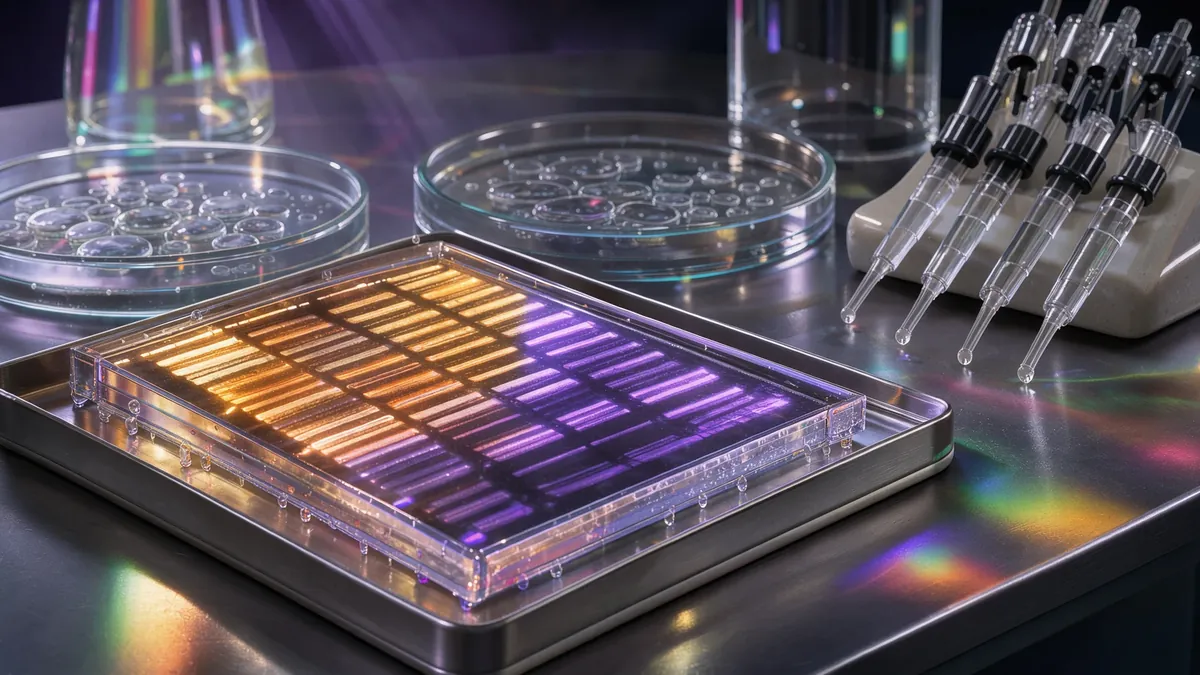
The benchmark consists of 100 routine tasks, ranging from simple tasks (reading a DNA fragment size on a gel) to detailed assay analyses, across five domains: proteins, imaging and cytometry, quantification, nucleic acids, and cloning. The datasets reflect what researchers actually handle: photos of gels and culture plates, microscopy image stacks, raw sequencing files, plate reader exports, videos of bench procedures, and photographed handwritten notes.
Each task was designed by a scientist based on their own experiments, accompanied by an expert rubric, and underwent three rounds of review, including one by an external PhD researcher. Scoring awards points criterion by criterion, including for correctly identifying when the data does not permit drawing a conclusion.
Astra leads an all-OpenAI leaderboard
At the highest reasoning effort shared across all tested models, GPT-6 Astra scored 66.7% of points, ahead of GPT-6.1 Sol (62.0%) and well above GPT-5.6 Sol (43.8%). OpenAI highlighted notable successes: Astra flagged that a control plate was labeled with the wrong antibiotic and rejected it, and recognized that a series of images where cells “vanished” was actually a microscope z-stack sweep.
The company also shared notable failures. Astra picked the wrong colonies because a familiar hypothesis overrode what the controls clearly indicated, dismissed observations that contradicted its conclusion, and overestimated a colony count by roughly 12%. OpenAI itself acknowledges that these scores do not yet mean a model can make dependable scientific judgments in a lab.
Our take
BioBasicsBench hits the mark: it is on unglamorous tasks—such as interpreting a gel or double-checking a control—that a lab assistant can save or waste weeks of work. The decision to reward answering “cannot conclude” is the most compelling aspect, as over-interpretation is often the costliest mistake in science. Yet the evaluation has an obvious blind spot: only OpenAI models were tested, on a benchmark built by OpenAI and a partner. Until third-party models are evaluated, all we know for sure is that Astra makes significant strides over the previous generation, not where it stands against the competition. Finally, OpenAI notes that monitoring these capabilities will help track biosecurity implications—a concern that will carry far more weight as scores continue to climb.
Sources
- OpenAI — Measuring how AI agents handle everyday wet-lab science (November 6, 2026) Primary source
- AI Affairs — OpenAI introduces BioBasicsBench to test AI agents on wet-lab tasks (November 7, 2026) Secondary source
A primary source comes directly from the company, lab or organization concerned. A secondary source reports the information without being its author: we flag it as such. Spotted an error? See our corrections policy.