Project Suncatcher: Google's Satellite Runs Gemma 4 on an Orbiting TPU
The Project Suncatcher prototype satellite, launched on October 1, has returned its first AI response: a haiku written by the open model Gemma 4 running on a data center-grade TPU chip. Google is now preparing thermal and radiation tests, ahead of launching two interconnected satellites in 2027.

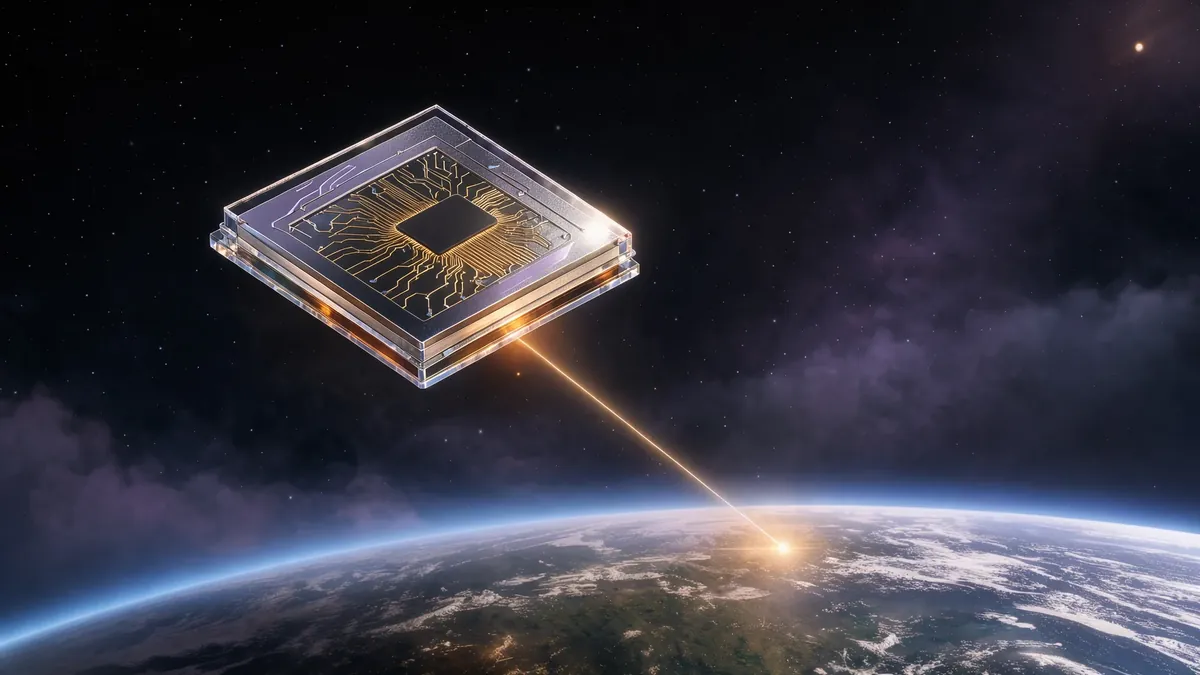
One month after its launch, Google’s Project Suncatcher prototype satellite has reached what the company calls its “Hello World” milestone: the first AI response generated by a data center-grade TPU chip in orbit. Google announced the achievement on Friday, October 30, and Sundar Pichai shared it on X at 6:05 p.m., Paris time. The response in question is a haiku.
An Open Model, a Prompt, a Poem
The satellite, built with Earth-imaging company Planet, was launched on October 1 aboard SpaceX’s Transporter-18 rideshare mission. Since then, the team has worked through its commissioning checklist: powering up the host computer and TPU trays, followed by preliminary machine learning tests.
This week, during a pass over a ground station, the team sent a prompt to the onboard open model Gemma 4: write a haiku about being in space. The response was beamed down as the satellite passed over Svalbard, Norway: “Blue marble below / Data streams in silent grace / Starlight feeds my core.” Google subsequently tried limericks and, more practically, queries asking the model to report the payload’s technical status.
The Real Test Begins Now
The haiku primarily proves that the end-to-end pipeline works: the chips survived launch, the software runs, and sending a prompt to receive a response succeeds. It says nothing about the chips’ long-term durability. That is the focus of the announced next steps: testing how the TPUs behave under thermal stress and radiation, two classic enemies of electronics in orbit. If these trials prove conclusive, Google is targeting a follow-up milestone in 2027: two interconnected satellites.
The satellite remains modest. According to TechCrunch, it carries four TPUs and generates up to 1 kW, which reportedly only allows running a single TPU for about twenty minutes at a stretch. Google does not provide these figures in its October 30 post.
Our take
Google frames Project Suncatcher as a long-term research endeavor: exploring whether space could one day host large-scale machine learning infrastructure. Between this ambition and satellite constellations capable of serving models at scale, everything remains to be proven: radiation tolerance, heat dissipation, inter-satellite links, and launch economics. This first haiku is a demonstration of functionality, not computing capacity; the results of the thermal and radiation tests, followed by the deployment of the two satellites planned for 2027, will reveal whether the project can evolve beyond an experimental proof of concept.
Sources
- Google — We've received our first response from the Project Suncatcher prototype satellite Primary source
- Google — Our Project Suncatcher prototype satellite is in orbit (October 1, 2026) Primary source
- Sundar Pichai (X) — announcement Primary source
- TechCrunch — Google's first data center satellite is online and writing poetry Secondary source
A primary source comes directly from the company, lab or organization concerned. A secondary source reports the information without being its author: we flag it as such. Spotted an error? See our corrections policy.