PAN 2: IFM's Open World Model Simulates in Video the Consequences of an Action Before an Agent Acts
MBZUAI's Institute of Foundation Models has released PAN 2, a world model that pairs a language model with a 29-billion-parameter diffusion model to simulate in video, up to 20 seconds, the outcome of actions described in text. Both code and weights are licensed under Apache 2.0.


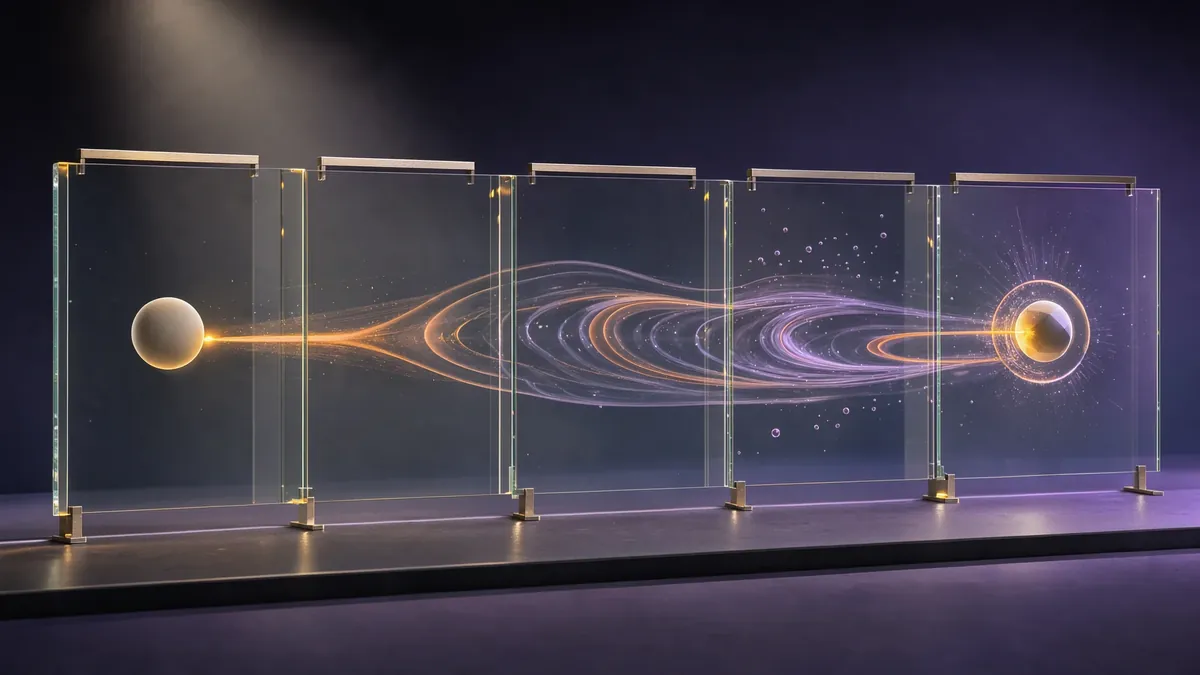
The Institute of Foundation Models (IFM), the foundation model laboratory at Emirati university MBZUAI, unveiled PAN 2 on November 10, 2026, an open world model. Its core principle is summed up by IFM’s phrasing: where a language model predicts the next word, PAN 2 predicts the “next world.” Given an image and text-described actions, it generates a video of up to 20 seconds showing what would happen next. Both the code and model weights are released under the Apache 2.0 license.
Two stages: the script, then the image
PAN 2 builds on the architecture of the first PAN, described by IFM in a November 2025 technical report, by splitting the process into two stages. A language model, which IFM terms “conceptual reasoning,” processes the initial observation and the requested actions, then drafts the next state of the world as a structured description: who does what, at what timestamp, and how the camera moves. A 29-billion-parameter diffusion model, trained from scratch on hundreds of millions of videos annotated in this exact format, handles “perceptual reasoning”: it fills in whatever the text leaves open (geometry, materials, motion details). The Wan 2.2 VAE decoder then converts the output into a 704 × 1248 video at 24 frames per second.
This two-stage design offers a practical advantage: any language model with strong instruction-following capabilities can serve as the first stage. The model card lists those tested in the report, ranked by their rate of successfully completed plans: Claude Opus 5.5, GPT-6 Astra, Kimi K3, and Qwen 3.8 Flash. IFM also provides a “skill” for coding agents along with a local script to reformat free-form prompts into the required structure.
The project page highlights three core aspects: time (altering the timing of an action changes the outcome, such as a surfer standing up too early or too late on a wave), physics (milk, ink, and oil poured into water do not behave the same way), and space (a room remains consistent even after a full 360-degree camera pan).
Hardware and deployment requirements
Only the diffusion model is released directly by IFM; the text encoder (Qwen3.5-9B) and the VAE (Wan 2.2) must be downloaded from their respective repositories under their own licenses. Each generation process loads the full 29-billion-parameter model onto a single GPU in BF16—meaning data center accelerators, not consumer hardware. The model card indicates support for Diffusers and vLLM, alongside IFM’s standalone script.
IFM strongly advises deploying the model behind a separately distributed guardrail, pan2-guardrail, which screens both input prompts before generation and the resulting video. The model card explicitly prohibits non-consensual deepfakes of real individuals, disinformation, and safety-critical decision-making without human oversight.
What remains to be verified
All published benchmark comparisons (Physics-IQ Verified, PhyGround, RBench, and human Elo ratings across 140 prompts evaluated by 13 reviewers) were produced in-house by IFM. The guardrail performance figures also stem from internal testing: it reportedly lowers the rate of harmful prompts yielding problematic videos from 33.9% to 1.5%, but at the cost of rejecting 11.5% of legitimate text-to-video requests.
IFM is candid about the system’s limitations: roughly two out of three simulated plans contain at least one step that goes unfulfilled; the model is sensitive to prompt wording; visual appearance tends to drift across clips during extended interactions; fine-grained manipulation (such as exact finger-object contact points) remains difficult to convey via text; and simulations can progress by cheating physical laws, such as pasta appearing in a colander before it is actually drained.
Our take
The race for world models is heating up: DeepMind with Genie 4, and Nvidia with Cosmos 3 Nano followed by GR00T 2. PAN 2 stands out on two fronts: an Apache 2.0 license that imposes no commercial restrictions, and a text-based first stage that makes every prediction human-readable before rendering pixels. This approach comes with trade-offs: what text struggles to capture—such as precise dexterity—the model struggles to simulate, constraining its immediate utility for fine-grained robotics. With two out of three plans remaining incomplete, PAN 2 is currently best viewed as a research sandbox for agents that “imagine” before acting, rather than a reliable physics engine.
Sources
- Institute of Foundation Models — PAN 2 announcement on X (November 10, 2026) Primary source
- Institute of Foundation Models — PAN 2 overview page Primary source
- Institute of Foundation Models — PAN 2 model card (Hugging Face) Primary source
- Institute of Foundation Models — PAN 2 code repository (GitHub) Primary source
- PAN Team, IFM — technical report for the first PAN (arXiv, November 2025) Primary source
A primary source comes directly from the company, lab or organization concerned. A secondary source reports the information without being its author: we flag it as such. Spotted an error? See our corrections policy.