Google DeepMind Unveils Gemini Robotics 2.5, Tested on Mercedes-Benz Lines with a 96% Success Rate
Google DeepMind introduced Gemini Robotics 2.5, its most capable vision-language-action model, evaluated across more than 200 tasks. In a pilot at Mercedes-Benz, Apptronik's Apollo 2 humanoid sorted automotive parts with a 96% success rate. For now, the model is restricted to Google's robotics partners.


Google DeepMind wants to bring robots out of the lab. On November 10, the research lab introduced Gemini Robotics 2.5, which it describes as its most capable vision-language-action (VLA) model yet: a system that takes in the scene, understands instructions, and directly controls a robot’s arms and hands. The model is currently rolling out to Google’s robotics partners, with no public access announced.
More tasks, performed faster
Google DeepMind reports evaluating Gemini Robotics 2.5 across more than 200 distinct tasks, chosen to combine tool use, flexible object manipulation, and delicate motions: serving food with tongs, tying a ribbon on a gift box, or pipetting liquids. Compared to its previous baselines, the lab claims a success rate that is 30% to 100% higher depending on the task type, with tasks executed 20% to 30% faster.
Like previous iterations, the model is not tied to a single robotic platform. Google DeepMind demonstrated it on Apptronik’s Apollo 2 humanoid, equipped with a 22-degree-of-freedom, five-fingered SharpaWave hand, as well as on the dual-arm Franka Duo setup, which relies solely on parallel grippers.
A factory floor pilot at Mercedes-Benz
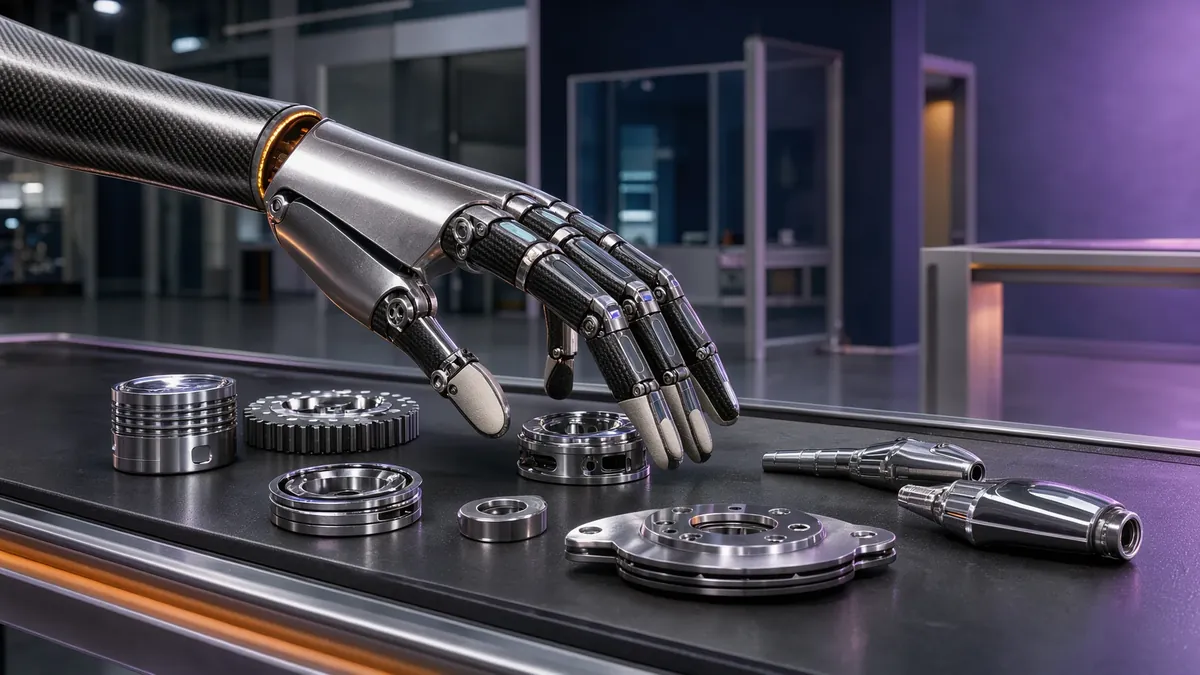
The most concrete milestone comes from a proof of concept conducted with Apptronik and Mercedes-Benz on active production lines in Kecskemét, Hungary, and Sindelfingen, Germany. There, Apollo 2 handled kitting tasks: picking bulk metal brackets from bins and placing them into sequencing trays in the exact order required for assembly. A reasoning model, Gemini Robotics ER, manages overall task planning, while Gemini Robotics 2.5 controls the hands and arms. According to Google DeepMind, the robot achieved a 96% success rate. Apptronik CEO Jeff Cardenas stated that the models “improved dramatically over just a few weeks” of fine-tuning and transferred to the factory floor “with very little degradation.”
Safety measured by a new open benchmark
The model relies on run-time reasoning guidance to navigate physical hazards in real time. In the lab’s evaluations, safe task completion increased by 33% around obstacles and by 43% near humans. Google DeepMind is also open-sourcing ASIMOV-Jailbreak, a benchmark featuring hundreds of prompts designed to disguise hazardous requests across dozens of scenarios. The headline figure here, however, belongs to Gemini 4 Argon, its frontier foundation model, which deflected 99.5% of these attempts, compared to 82% for the older Gemini Robotics ER 2.
Using an LLM to generate training data
Gemini 4 Argon also served as a development accelerator. From a single real-world camera view, it generated a digital twin and thousands of simulated variations, which were then combined with real demonstration data. It also helped researchers formulate hypotheses regarding failure modes from video recordings, enabling rapid testing of fixes in simulation and on physical hardware.
What remains unverified
All reported metrics come strictly from Google DeepMind and its partners; no third-party evaluation has been published. The blog post does not specify the duration of the Mercedes-Benz trial, the total volume of parts processed, or the cycle time compared to a human worker. Furthermore, Google provided no pricing, public API details, or release roadmap, and there is no indication that the model weights will be released.
Our take
This announcement comes right on the heels of Nvidia’s GR00T 2 unveiling, highlighting two divergent strategies. Nvidia is betting on an open model, public datasets, and measurable generalization across unseen tasks. Google, by contrast, is keeping its model locked down with select partners while highlighting a concrete industrial deployment. The 96% success rate at Mercedes-Benz is compelling, but it applies to a repetitive, tightly bounded task; in automotive manufacturing, a 4% failure rate remains costly if each error stops the line or requires technician intervention. The most intriguing technical angle is using a frontier LLM to synthesize simulation environments: if this holds up, robotic learning speeds will soon depend as much on language models as on collected physical demonstration hours. Finally, open-sourcing ASIMOV-Jailbreak gives the broader research community a shared yardstick, something robotics safety evaluations still sorely lack.
Sources
- Google DeepMind — Gemini Robotics 2.5 accelerates real-world general dexterity (November 10, 2026) Primary source
- Google DeepMind on X — Gemini Robotics 2.5 announcement (November 10, 2026) Primary source
A primary source comes directly from the company, lab or organization concerned. A secondary source reports the information without being its author: we flag it as such. Spotted an error? See our corrections policy.